Notes from the field on industrial measurement

Thermocouple or RTD: deciding at the measuring point

A thermocouple and an RTD can sit in the same pipe and still give different answers. Which one belongs there depends on three things: temperature, how fast it changes, and how long the reading must stay stable.

How does each one measure temperature? A thermocouple produces a small voltage where two dissimilar metals meet at different temperatures. An RTD measures the resistance of a metal, usually platinum; a Pt100 element reads 100 ohms at 0 °C. That defined relationship makes verification straightforward.

Which one handles high temperature? Thermocouples. They are used in furnaces and kilns where an RTD element would not survive, and they react faster because the junction can be small.

Which one stays stable longer? RTDs in moderate ranges. Their signal drifts less, which is why they are common on process lines and bearing temperature monitoring.

What about installation? A thermocouple can be a thin armoured probe bent into a tight space. An RTD needs a three- or four-wire connection when the cable run is long, because lead resistance otherwise enters the measurement.

Neither is universally better. Start with the range and the medium, then pick the construction.

Source: Compiled from public industry references
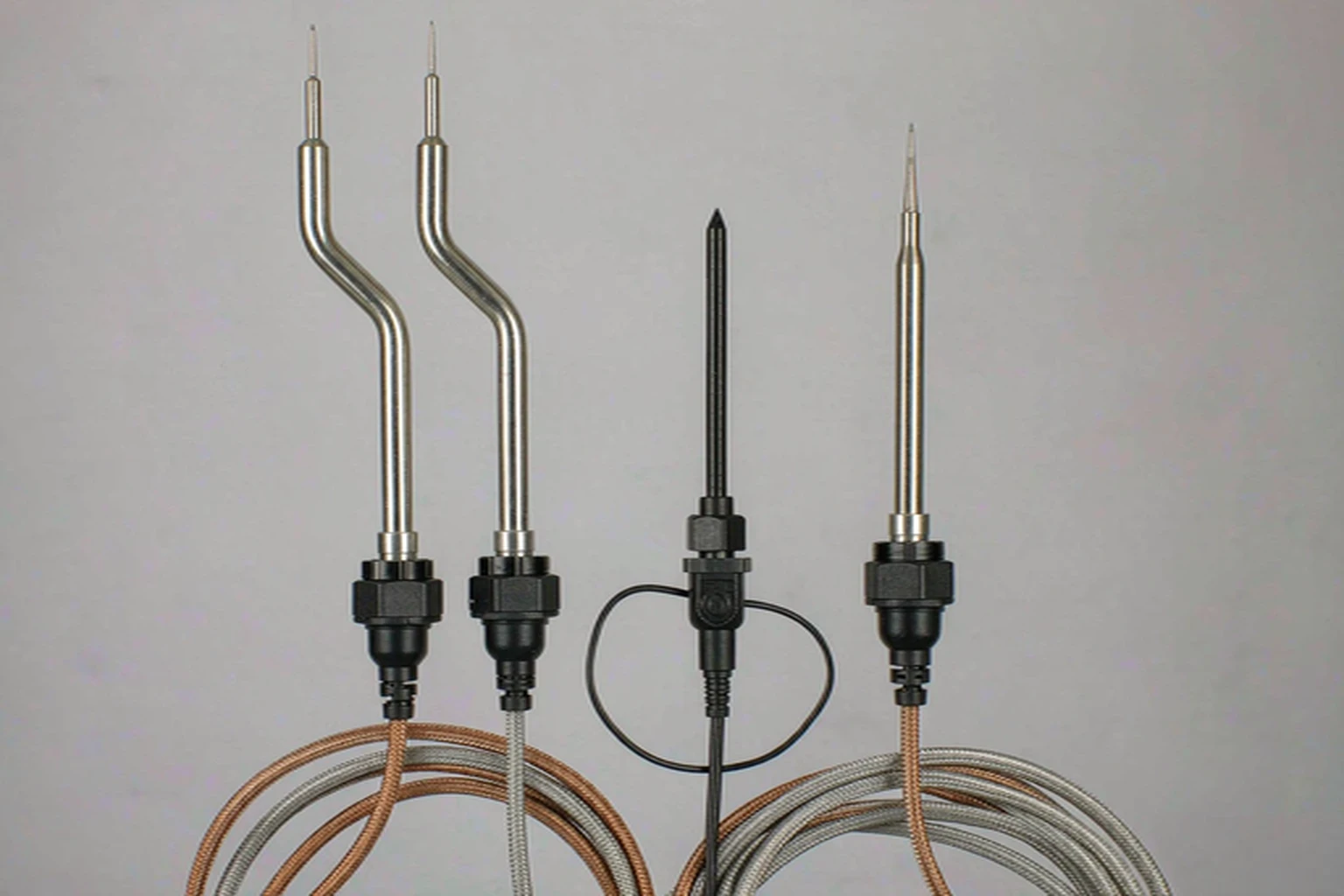
Two thermocouple probes and a platinum RTD probe arranged side by side for comparison

Differential pressure: one signal doing three measurement jobs

Differential pressure is one of the oldest measurements in process plants, and it is still everywhere. The reason is simple: a pressure difference is easy to generate, easy to transmit and easy to relate to something else.

How does it measure flow? Put a restriction in a pipe and pressure drops across it. The faster the fluid moves, the larger the drop. From that difference, flow rate can be calculated. Orifice plates, V-cones and averaging tubes all work this way.

How does it measure level? In a closed tank, pressure at the bottom equals the liquid head plus the gas pressure above it. Measure the bottom pressure and subtract the vapour-space pressure, and what remains is the liquid height.

How does it monitor a filter? A clean filter has a small pressure drop. As it loads with solids, the drop grows. The differential transmitter shows when to change the element without opening the housing.

Why not replace it with something newer? Radar and electromagnetic meters have their own advantages, but a differential transmitter has no moving parts, works on steam and gas, and can be checked in place. The weak points are impulse lines that plug or freeze, and sealing liquid head when remote seals are used. Most field problems come from those lines rather than from the transmitter itself.

Source: Compiled from public industry references
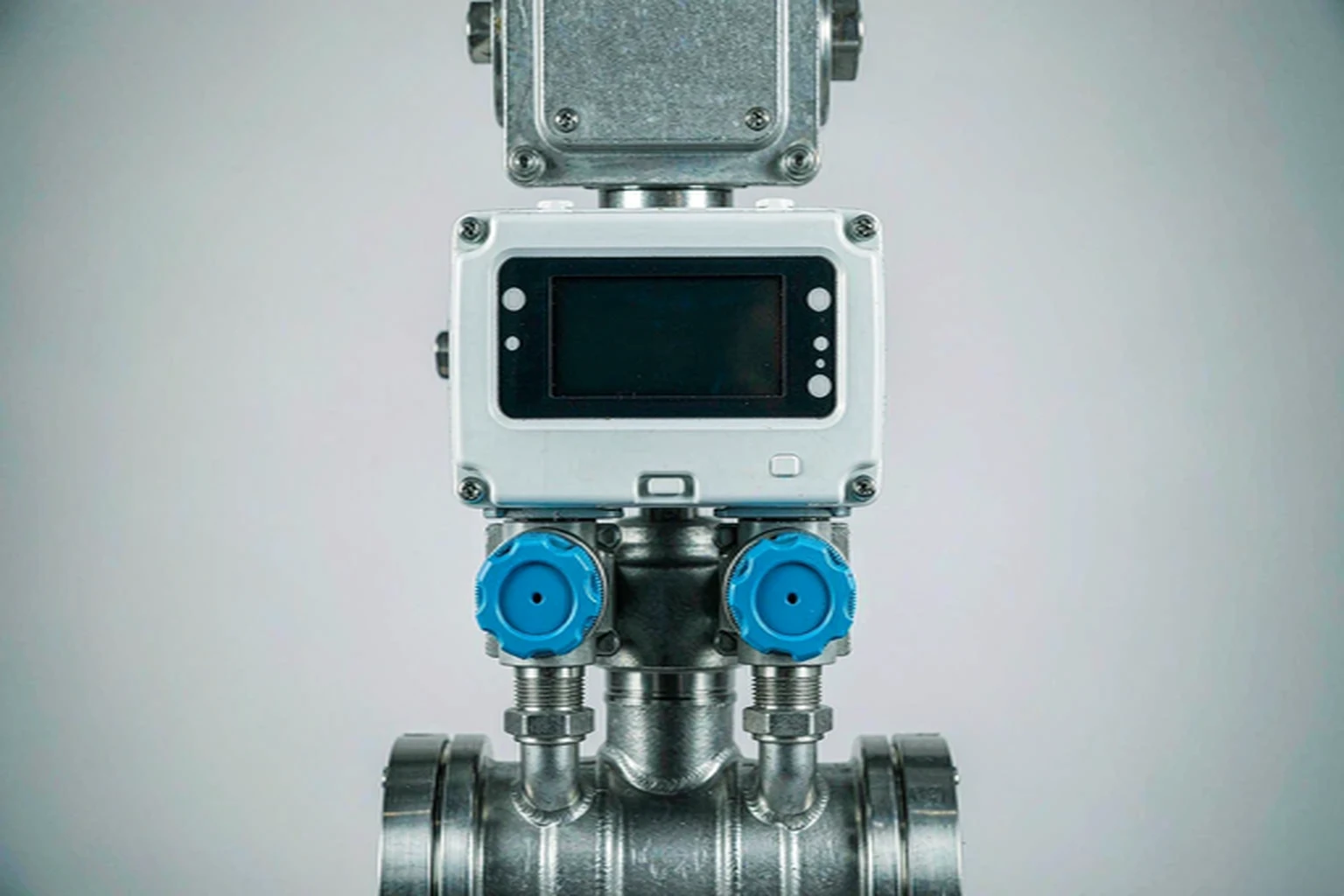
Differential pressure transmitter with two impulse ports mounted on a process pipe

Measuring steam flow: why vortex meters keep showing up

Steam is awkward to measure. Its density changes with pressure and temperature, and condensate can collect in a line that was installed correctly. A vortex meter is common on steam duty for a practical reason: one sensor handles steam, gas and liquid without a pressure tap filled with sealing fluid.

How does it work? A bluff body stands in the pipe. Fluid passing it sheds vortices alternately from each side, and the shedding frequency is proportional to flow velocity. A sensor detects the pressure pulses and the converter turns the frequency into a flow reading.

What does the installation decide? Straight pipe before and after the meter matters. Fewer fittings upstream mean a more stable velocity profile. Vibration is the other enemy: the sensor is measuring small pressure pulses, so a pump bolted to the same structure can appear as flow.

Do I need compensation? For saturated steam, pressure compensation is often enough. For superheated steam, both pressure and temperature are normally needed to correct density. Without it, the meter reports volume at line conditions rather than mass.

When is it the wrong choice? Very low flow, high vibration, or dirty wet steam that erodes the bluff body. In those cases a differential pressure primary element or a thermal meter may be more appropriate.

Source: Compiled from public industry references
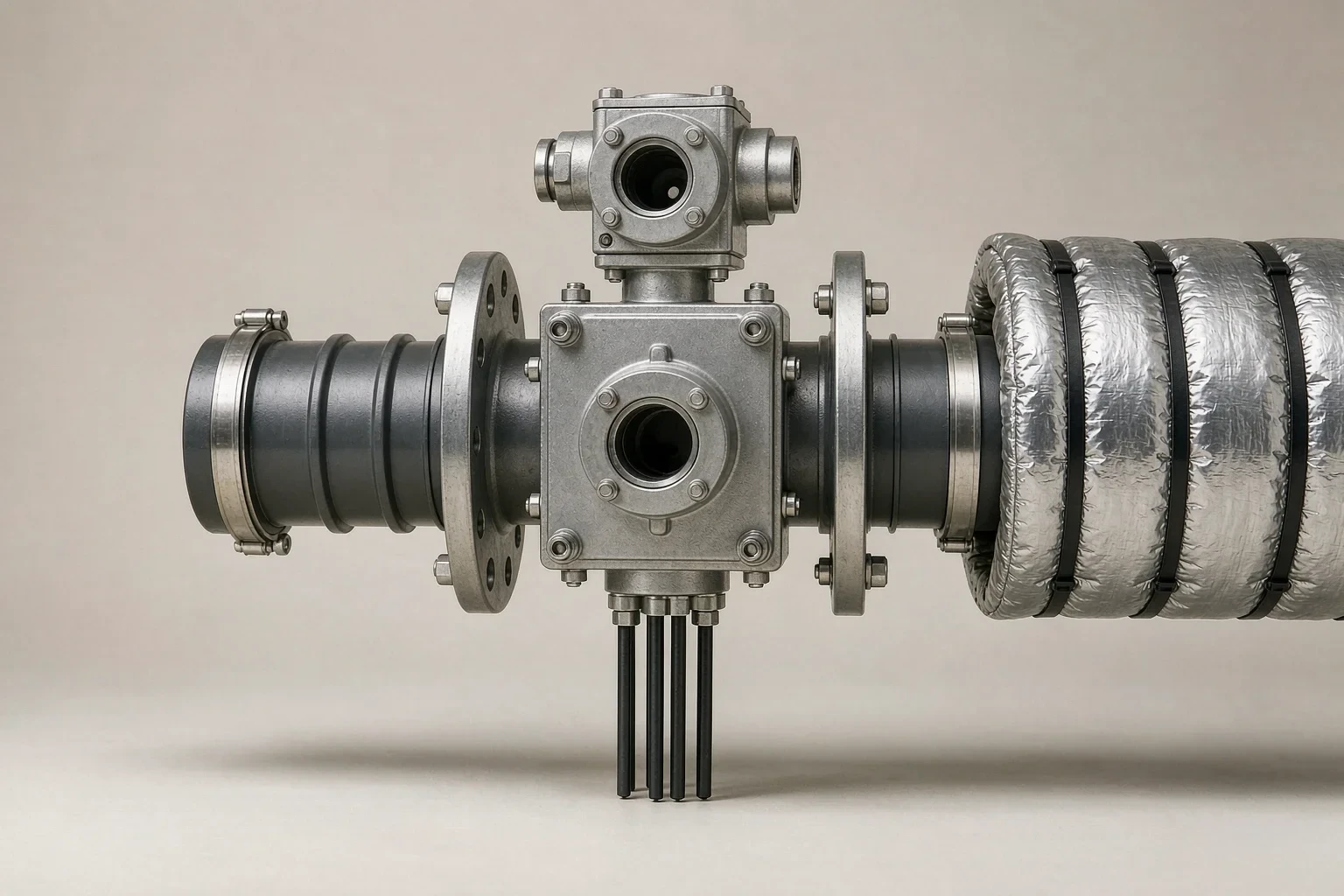
Vortex flow meter on an insulated steam pipeline

Radar or ultrasonic: choosing a level meter for a dusty silo

A silo full of powder looks simple on a drawing. In practice, filling creates dust, the surface is rarely flat, and material can stick to the wall. Those three details decide whether a level instrument gives a usable reading.

What does ultrasonic measure? It sends a sound pulse to the surface and times the echo. The method is non-contact and inexpensive to install. Dust scatters the sound, and foam or a steep angle of repose weakens the return. It works best on calm liquids in open vessels.

What does radar measure? Microwave pulses travel to the surface and return. Microwaves are far less affected by dust and vapour, so radar is the usual choice for silos, closed tanks and vessels with temperature stratification. Antenna choice still matters: dust buildup on the antenna must be considered.

What about the blind zone? Every non-contact instrument has a minimum distance near the sensor where it cannot measure. On a tank that fills close to the roof, this small distance can be the difference between a working instrument and a false high-level alarm.

What if the surface is not flat? Filling produces a cone. A single point measures the distance directly below it, not the average level. Many installations use a stilling well or average several readings to reduce that error.

The practical rule: clean open liquid — ultrasonic; dust, vapour or a closed vessel — radar.

Source: Compiled from public industry references
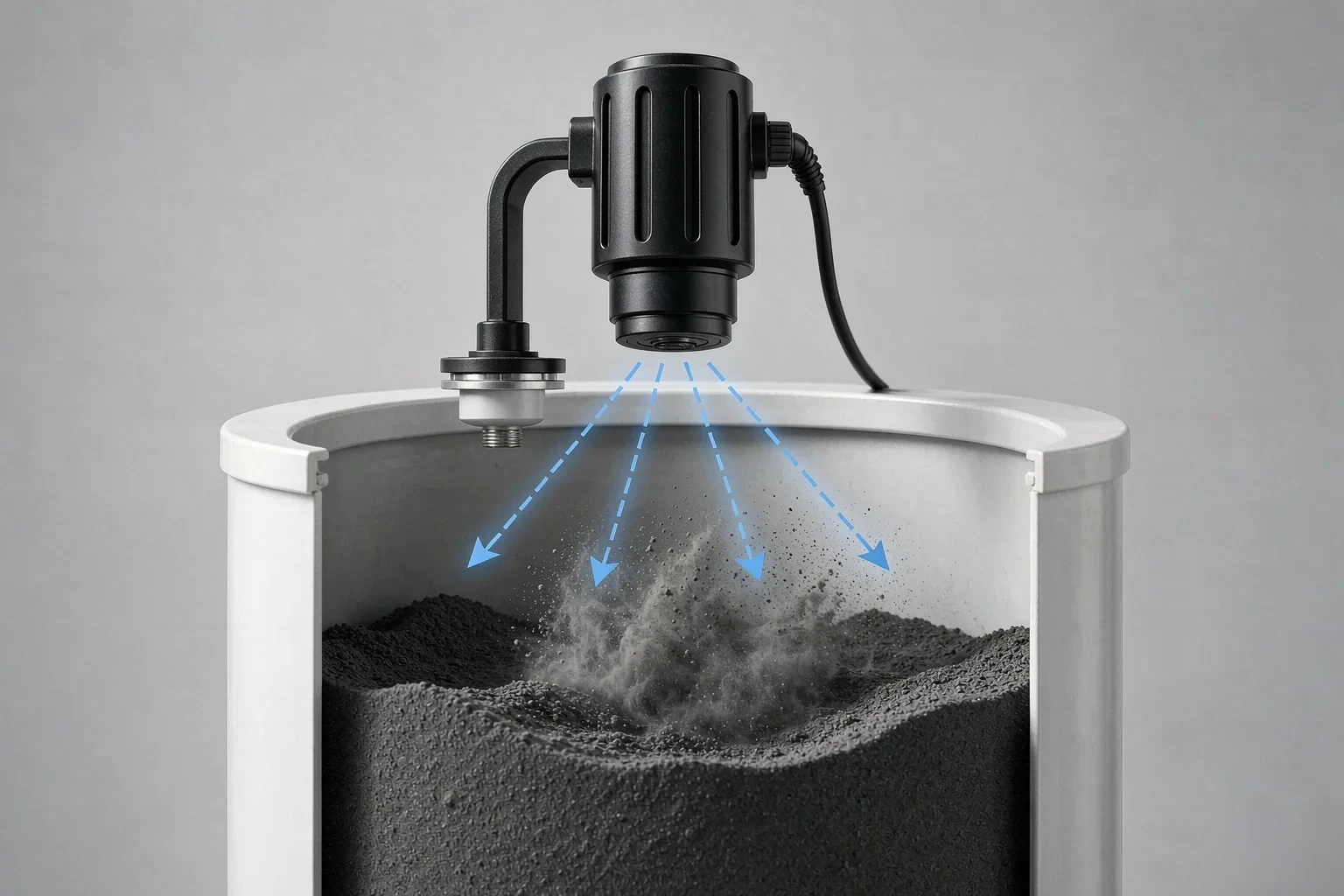
Radar level meter on top of a silo with dust inside the vessel

Have a measuring point to spec?

Send the medium, operating temperature and installation. We will come back with the instrument type, connection and signal.

Talk to our team